
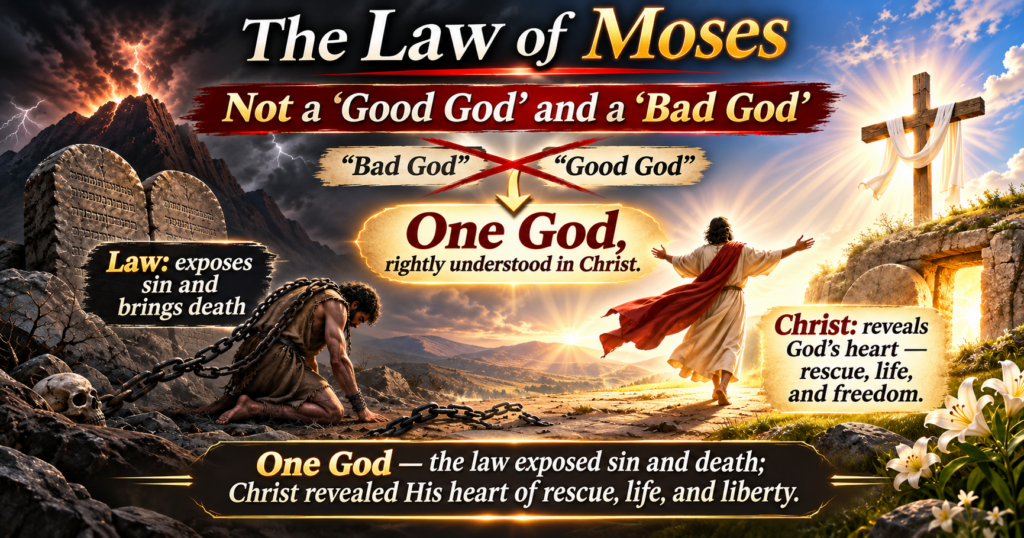
It is very clear in the Pauline letters that the law of Moses brought death. That is all it could do for man, that’s its ultimate goal. Not righteousness only death. Moses got that right, 100%. He administered that covenant with Israel correctly (not always perfectly). The law is not rightfully understood though apart from Christ, it’s a partial story, just the first part, So as God created gravity perfect in its work so He created the law, a perfect signpost pointing to Christ. So when you see YHWH said put them all to death that was the administration of the law. That was not however YHWH’s heart for the world. As we read in John He does not want anyone to perish. Then we read in Paul’s letters he actually rescued everyone from death in Christ. So it was the law (the letter) that killed everyone in the time of Moses not the will of YHWH, His will was rescue not death. He created gravity, it’s not his will for you to jump out of an airplane without a parachute and the law of gravity will remain in effect the entire fall down, just like the law.
So if that’s the case why have the law at all though? Why not ever release the law so we didn’t see all this judgement and death before Christ? Why not skip that part and go straight to Jesus? The law was for us to see what sin was, not just see it though but to activate it. We didn’t know what sin was until we heard about the law, then the second we heard of sin… judgement and death. So the law activated sin, perfectly. When Jesus body was nailed to the cross something needed to be nailed to it and that something was sin. Not just any one persons sin, but the sin of the whole world. Without the manifestation of sin and death (because the law perfectly activates it) the cross would have no meaning. So the law activates sin which then creates a judgement for the whole world, at which point God in Christ could nail it to the cross fulfilling the whole point of the law, freedom from sin.
So when you read scriptures in the Old Testament about YHWH this and YHWH that and it involves death and destruction, realize that is a clear administration of the law. If we were under the law that is the kind of life we would experience, not a good one. Not because YHWH has an “evil” side but because the law of Moses when administered correctly brings death.
So the point of everything (and I mean literally everything, the entire creation) is Christ Jesus. Instead of working hard at the law (something that just brings your demise) he transformed us into His own image and likeness. A perfect man (mature), a son of God. No longer do we need a list of rules, do’s and don’ts but our very nature has been transformed back to our source and the law is now the perfect (mature) law of liberty. We can now live as ourselves in Christ fully righteous, fully holy just like He is. It’s not our fault and it’s not based on anything we could do, but it’s fully based on the fact that the sin of the world was nailed to the cross, causing death and then Holy Spirit raised Christ from the dead as the new man, the second Adam, and we have been raised with Him, incorruptible and full of glory (goodness). As He is so are we in this world.
#biblestudy
Reference:
2 Corinthians 3 starting in verse 4
Christ is proof of our persuasion about you before God. (The Greek Preposition pros, means towards; face-to-face. Also 2 Cor 1:18,19,20.) We have not reached this conclusion by any merit of our own. Of God’s doing are we made competent. (The word, logitsomai, means to reckon; making a calculation to which there can only be one logical conclusion.)
It is God’s signature in our spirit that authorizes New Testament ministry. We are not qualified by a legal document endorsed by a fellow human. The letter [of the law] is the administration of death; it is the Spirit [of grace] that quickens life. Because of its prophetic purpose even the old administration of death, carved in stone evidenced a glimpse of glory; for a brief moment the face of Moses shone with such brilliance that the people of Israel could not even look at his face. The fact that the glory reflected in Moses was brief and fading confirmed that the ministry of the letter had a “sell by” date and that it was destined to be brought to nought. (It served merely to emphasize the failure of the flesh to access the glory that Adam had lost on mankind’s behalf. The word, katargeo, derives from kata, meaning intensity, and argos, meaning labor, denotes that the law of works would be rendered entirely useless; thus, the new arrangement would free us from all self effort to attempt to improve what God has already perfected in Christ. Consider the contrast in verse 18; from a mere glimpse of a veiled and fading glory to unveiled gazing into the face of glory as in a mirror and a transformed life radiating the same glory.) How much more radiant would the ministry of the Spirit be.
If the ministry of condemnation had a glimpse of glory, the glory that the ministry of righteousness now communicates is beyond comparison. (There are two administrations: the one confirms mankind’s guilt because of Adam; the other confirms mankind’s innocence because of Christ. The one was upheld by the letter of the law; the other is sustained by the life of the Spirit. Mankind’s standing before God is restored; righteousness by the merit of the cross far outweighs any attempt of the flesh to compete. Nothing that anyone can do can improve their standing before God.)
What seemed glorious and important at the time has been reduced to total obscurity and irrelevance. The fragile and fading glory of the flesh is dwarfed into insignificance by the unfading glory of the Spirit. (The ministry of the New Testament reveals oneness and permanence. In Christ the idea of distance and delay is canceled.)
Our every expectation is fulfilled; therefore, we speak with clarity and conviction. (Every definition of veil is removed from our conversation. We have no hidden agenda. This is what we say as plainly as possible: the glory that Adam lost on mankind’s behalf, Jesus redeemed. The image and likeness of God is no longer a future promise of possibilities and potential; it is our reality and reference now. See Col 1:27.)
What we say is so unlike Moses who had to keep Israel in suspense with a veiled face; they did not realize that this arrangement would never suffice to secure their standing before God. In essence the letters on stone confirmed their death. All that they could see was the futility of the law of works; how entirely useless their best attempts would be to match the life of their design. (In Adam all people alike stood condemned; they did not realize it until the law revealed it. In Christ all are declared innocent; yet they do not know it until the Gospel reveals it. Rom 10:17 and Rom 7:4-25.)
Since the time of Moses until this very day their minds remain calloused and veiled. They are kept in suspense without realizing that there is no glory left in the law: (whatever glory there was, carried merely a fading, prophetic glimmer) reading the Old Covenant without understanding that Christ is the fulfillment of Scripture is a complete waste of time. Only in discovering our union with Christ is the veil removed and do we realize that the old system is rendered entirely useless. (The word katergeo comes from kata, meaning intensity, and argos, meaning labor, the law of works is rendered entirely useless; thus the new arrangement frees us from all self effort to attempt to improve what God has already perfected in Christ.)
In the meantime nothing seems to have changed; the same veil continues to blindfold the hearts of people whenever Moses is read. (Moses symbolizes the futility of self righteousness as the global blindfold of the religious world. [John 1:17] Against the stark backdrop of the law; with Moses representing the condemned state of mankind, Jesus Christ unveils grace and truth. He is the life of our design redeemed in human form.) The moment anyone returns to the Lord the veil is gone.
- du Toit, Francois. Mirror Study Bible